Original field inspection
What I Found Inspecting My AC, Boiler, and Water Heater Before Annual Service
I photographed the accessible parts of three working home systems before their next service visit, recorded what looked normal, found one real maintenance item, and stopped where professional service made more sense.
Scope of this article
This is a pre-service visual inspection of working equipment, not a substitute for HVAC or gas-appliance service. I stayed with accessible components, documented what I could actually observe, and stopped where refrigerant, combustion, safety controls, or difficult attic access would have turned an inspection into service work.
The goal was not to invent maintenance for relatively new equipment. It was to establish a real baseline, find anything visible that deserved attention, and arrive at the next service visit with better questions. That approach produced one definite maintenance item on the AC, a useful component map of the boiler, and a more grounded picture of a 2017 water heater.
Central air
The AC inspection found one small but real maintenance item
The outdoor condenser is a Bryant 126BNA024-A. Its data plate shows an April 2022 manufacture date, R-410A refrigerant, a 208 to 230 volt single-phase supply, and a maximum 25 amp fuse or circuit breaker. The exterior coil was generally open when photographed. Light debris and cobwebbing were more noticeable near the bottom, but there was no heavy blanket covering the visible fins.
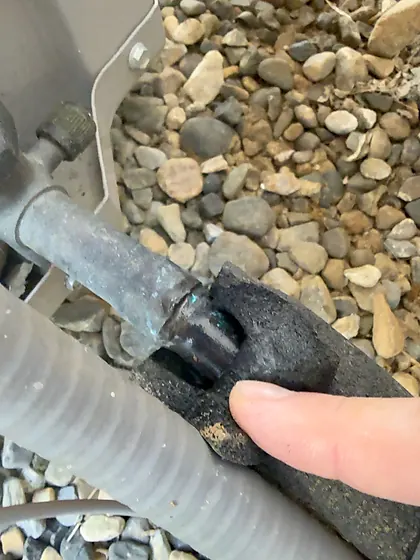
The useful finding was at the larger insulated refrigerant line near the condenser. A short section of the black foam had opened enough to expose the line beneath it. Farther toward the house, the insulation showed normal outdoor weathering but remained substantially intact. Because annual AC service is already scheduled, I documented the damaged area for the technician instead of removing panels or duplicating the professional cleaning.
The indoor air handler is in an attic that is awkward to reach. I did not climb into it simply for an article. Routine filter access is much easier because the 14 by 24 by 1 filter sits in a hinged return-air grille inside the house. That is an important part of the maintenance plan: use the safe, accessible service points and leave difficult equipment access to the visit that is already scheduled.
Hydronic heat
The boiler inspection became a map of a real system
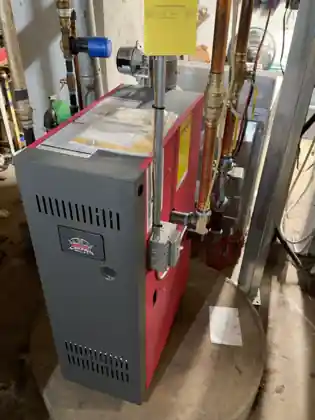
The boiler service tag records a new installation on October 27, 2023. The equipment label identifies a Crown AWR070BNT3SU1, and the front EnergyGuide label shows 84 AFUE. From the accessible exterior, the copper and black-iron piping looked clean for its age, with no obvious active seepage or heavy corrosion in the areas photographed.
The inspection identified the Taco 007-F5 circulator, the gray Zilmet Cal-Pro hydronic expansion tank, the 30 PSI safety relief valve and its open-ended copper discharge tube, the automatic vent damper, isolation valves, and the Watts boiler-feed/backflow assembly. The relief valve body appeared dry in the close photo, and the discharge tube terminated open near the floor rather than being capped.
The expansion-tank label was readable despite the wall clearance. It showed 4.8 gallons of volume, a 60 PSI maximum working pressure, a 210°F maximum operating temperature, and a 12 PSI factory precharge. The Taco circulator label identified it directly as a 007-F5 cartridge circulator. Those photographs make it possible to explain what the components do without pretending they were disassembled or tested.
One item remains unresolved. I could not find a readable boiler temperature/pressure gauge from the accessible angles. Crown documentation for the AWR family includes a combination temperature/pressure gauge, so I am not calling the installation incorrect. I am asking the technician to show me where operating pressure and temperature are read on this installation.
Domestic hot water
The older water heater was dry where it mattered during this check
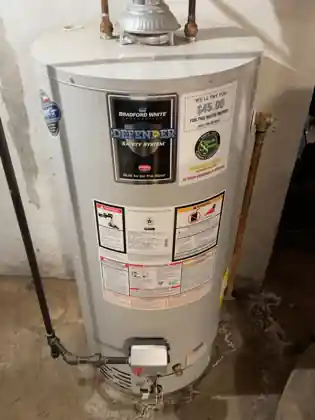
The water heater is a Bradford White RG240S6N, a 40-gallon natural-gas atmospheric-vent model rated at 40,000 BTU per hour on its label. Its serial number begins PB. Bradford White uses the first two serial characters as its year and month code. In the context of this installed unit, PB corresponds to February 2017.
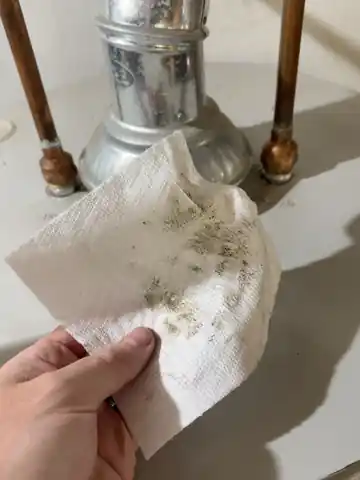
The hot and cold connections on top show visible age, oxidation, and discoloration. Instead of calling that a leak from appearance alone, I wiped the accessible fittings with a clean white paper towel. The towel picked up dry grime and residue but no obvious fresh moisture. That observation does not prove the tank or every joint is permanently leak-free. It records what was actually present on September 19, 2026.
The floor beside the tank has dark staining, but that has known history: it came from a previous bathroom leak. It is not being presented here as evidence against the water heater. Context like that matters in a hands-on article because a photograph can otherwise suggest a failure that was never observed.
Service handoff
The inspection produced better questions, not a shopping list
Inspect the localized suction-line insulation opening and tell me whether the exposed section should be repaired or replaced during service. Document the normal cleaning and operating checks.
Show me where the system temperature and pressure are read. Verify the safety controls, relief system, feed-water regulator, backflow protection, burner operation, and venting during the scheduled service.
Confirm whether the tank is included in annual service, whether it has been drained or flushed before, whether the anode rod has ever been inspected or replaced, and whether its current condition suggests planning for replacement.
Until the water heater's maintenance history is clear, I am not turning a 2017 tank into a first-time flushing experiment for the sake of content. The same rule applies to the boiler relief valve and feed-water controls: photographing and identifying them is useful, but operating or adjusting them just to make an article is not.
Evidence limits
What this inspection cannot prove
Nothing photographed here proves refrigerant charge, combustion quality, flue draft, boiler operating pressure, relief-valve opening performance, backflow-preventer function, or the internal condition of the water-heater tank. Those questions require the appropriate access, instruments, procedures, and sometimes licensed or trained service.
What the inspection does provide is a dated baseline. If corrosion, insulation damage, seepage, noise, or other visible conditions change, these original photographs show what the same equipment looked like before the October 2026 service. I will update this article with the technician's actual findings rather than writing those findings in advance.
Common questions
What I would and would not do from here
Do I need to open my AC condenser to inspect it?
Not for the checks documented here. I photographed the exterior coil, line insulation, service connections, electrical whip, and surrounding area without removing a panel. The system already has professional service scheduled.
Is discolored copper around a water heater automatically a leak?
No. Discoloration can remain after old moisture, flux, oxidation, or ordinary aging. On this tank, the fittings looked aged but a clean paper-towel check found no obvious fresh water at the time of inspection.
Should I operate a boiler relief valve just to test it myself?
This article does not recommend operating safety valves merely for documentation. The boiler already has scheduled professional service, so the relief valve and related safety checks are being left to that visit.
Why not flush the 2017 water heater now?
Its maintenance history is uncertain. Before turning a nearly decade-old tank with unknown prior service into a first-time flushing experiment, I want the service technician to confirm whether it has been flushed before and assess its present condition.
Sources and credits
Manufacturer documentation used
Equipment identity and field observations come from the original photographs taken during this inspection. Manufacturer sources below were used to check component purpose, model documentation, and maintenance context.
- Bryant: Maintaining your Bryant system
- Bryant: HVAC air filters
- Crown Boiler: Aruba 5 (AWR) documentation
- Taco Comfort Solutions: Model 007 cartridge circulator
- Watts: BD911 combination fill valve and backflow preventer
- Zilmet: Cal-Pro hydronic expansion tank catalog
- Bradford White: Serial-number date-code chart
- Bradford White: Atmospheric-vent gas water-heater technical documents
- Trusted Home Essentials editorial policy
Next update
This article is designed to get better after the service visit.
The October service will add the professional findings that today's accessible inspection cannot supply. That follow-up will be dated and separated from the observations recorded here.