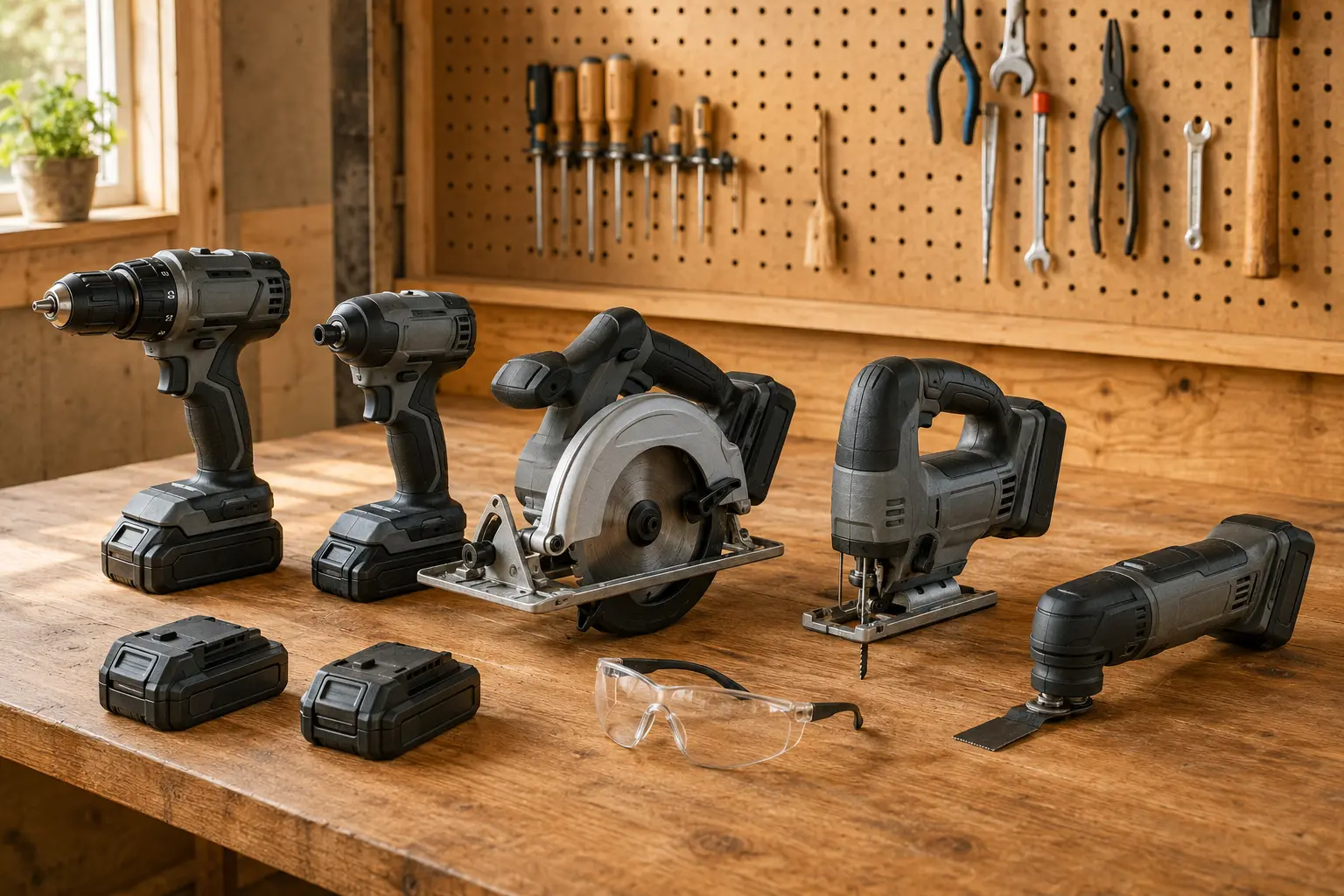
Before tool number one
Choose the battery platform before you build the collection
A cordless-tool purchase is also a battery-system decision. Future bare tools are economical only when their approved batteries and charger already fit your platform. Compare the exact models, battery availability, local service, warranty, tool range, charger, and the kind of outdoor equipment you may add later.
Do not compare brands by the voltage headline alone. In its cordless-platform overview, DEWALT explains that 20V MAX describes maximum initial voltage while nominal voltage is 18V. Amp-hours primarily describe battery capacity, not an independent measure of tool power. Compact packs keep a drill lighter; higher-demand saws can justify larger approved packs when the manufacturer permits them.
The original Pin's linked kit
DEWALT DCK240C2 two-tool kit
DEWALT identifies the DCK240C2 in its official product listing as a drill/driver and 1/4-inch impact-driver kit with two compact 1.3 Ah batteries, a charger, and a bag. It covers the first two categories in this guide, but those compact packs may limit runtime in higher-demand saw use. Trusted Home Essentials has not completed hands-on testing of this kit.
Confirm the current model, seller, contents, warranty, price, and availability before ordering.
Buy first
Cordless drill/driver
Drilling holes and ordinary screwdriving
A drill/driver combines a three-jaw chuck for common drill and driver-bit shanks with an adjustable clutch that can limit fastening torque. That combination makes it more versatile than the other four tools on this list.
Multiple speed ranges help separate slower, more controlled fastening from higher-speed drilling. A standard drill/driver is not automatically a hammer drill, so masonry impact action must be listed as an actual mode before you count on it.
You want one broad-purpose power tool for repairs, anchors, pilot holes, furniture, and general fastening.
Wait only when you already own a suitable drill/driver or your work is limited to light hand-tool tasks.
Three checks before buying
- Comfort, balance, and total weight with the battery installed
- Chuck size and the bit-shank range accepted by the exact model
- A usable clutch, multiple speeds, and locally available service or warranty support
A bound bit can twist the tool opposite the direction of rotation. Brace the tool, release the trigger immediately, remove the battery before clearing the bind, and check behind walls for electrical, water, or gas lines before drilling.
Buy for repeated fastening
Cordless impact driver
Long screws and higher-resistance fastening
An impact driver adds rotational impacts as resistance rises. That makes it well suited to driving long or resistant fasteners while minimizing torque reaction compared with a standard drill.
Most common models use a 1/4-inch hex interface. An impact driver is not an impact wrench, which normally uses a larger square drive for nuts and bolts, and it should not be treated as the default tool for vehicle lug nuts.
Decking, framing, shelving, structural screws, or repeated fastening makes an ordinary drill slow or tiring.
Your work is mostly small household screws, delicate hardware, or occasional furniture assembly.
Three checks before buying
- Variable speed and enough low-speed control for the fasteners you use
- A 1/4-inch hex interface and impact-rated bits or accessories
- Noise, weight, lighting, and whether the tool shares your existing batteries
Use only accessories rated for impact use, wear hearing protection when exposure requires it, and stop before repeated impacting strips threads or breaks a fastener.
Buy for straight cuts
Cordless circular saw
Straight cuts in lumber and sheet goods
A handheld circular saw is the production cutter in this group. With the correct blade it can crosscut lumber, rip along the grain, and break down sheet goods much faster than a jigsaw.
Blade diameter, arbor, material rating, and maximum rated speed must match the saw. Battery size also matters more here than it does for light fastening because sawing is a higher-demand application.
Shelves, framing, plywood, fencing, decking, or outdoor projects require repeatable straight cuts.
You make only rare cuts that can be safely completed with a borrowed, rented, or shop-cut tool.
Three checks before buying
- Blade diameter, maximum cutting depth, bevel range, and arbor requirements
- Clear sight lines, dependable upper and lower guards, and a stable shoe
- Battery capacity, charger time, replacement blades, and tool weight
Check both guards before every cut, support the work so the kerf cannot close on the blade, keep your body out of the blade line, and set cutting depth only slightly beyond the workpiece as directed by the tool manual.
Buy for curves and cutouts
Cordless jigsaw
Curved cuts, openings, and detailed shapes
A jigsaw trades straight-line speed for maneuverability. The correct blade lets it cut curves and openings in materials such as wood or metal, subject to the exact saw and blade rating.
Orbital-action settings are model-dependent. More aggressive action generally favors faster cutting, while lower settings favor finer finishes. Blade-shank compatibility also varies, so a blade described as common is not automatically compatible with every jigsaw.
You need sink cutouts, panel openings, curves, notches, or shaped work that a circular saw cannot follow.
Nearly all of your planned cuts are long and straight, where a circular saw is the better first choice.
Three checks before buying
- Blade-shank type, material-specific blade availability, and tool-free blade changes
- Variable speed, orbital settings, bevel capability, and a stable shoe
- Dust visibility, vibration, battery fit, and the cut capacity of the exact model
Clamp the work, keep the shoe firmly supported, use a sharp material-appropriate blade that clears the work through its full stroke, and wait for the blade to stop before removing or setting down the saw.
Buy for repair access
Cordless oscillating multi-tool
Flush cuts, plunge cuts, scraping, grout, and tight spaces
The oscillating multi-tool is the problem-solver in the group. With the correct accessory it can make flush or plunge cuts, scrape adhesive, remove grout, and handle smaller sanding work in confined areas.
Accessory fit is a real purchasing constraint. Labels such as universal fit can still exclude certain mounts or require adapters, so physical attachment alone does not establish safe compatibility.
Repair and remodeling work repeatedly puts you against trim, flooring, drywall, grout, adhesive, or an obstruction that ordinary saws cannot reach cleanly.
You mainly need fast production cutting or large-area sanding, where dedicated tools are more effective.
Three checks before buying
- The accessory interface and the cost and availability of compatible blades
- Variable speed, vibration control, lighting, and tool-free accessory changes
- Whether the included accessories actually match wood, metal, grout, or scraping work
Confirm the accessory is rated for the material and mount, remove the battery before changing it, control dust appropriately, and remember that blades, accessories, and workpieces can remain hot after use.
Project matching
Choose the tool combination by the work
A five-tool bundle can look economical while still including tools you rarely use, small batteries, or older models. Map the next six months of likely projects before paying for the collection.
Wall anchors, furniture, and basic repairs
- Start with
- Drill/driver
- Add when needed
- Impact driver only for repeated or resistant fastening
Shelves, framing, fencing, and decking
- Start with
- Drill/driver and circular saw
- Add when needed
- Impact driver for repeated structural fastening
Countertop, sink, vent, or panel openings
- Start with
- Drill/driver and jigsaw
- Add when needed
- Circular saw when the project also includes long straight cuts
Trim, flooring, drywall, grout, and repair access
- Start with
- Drill/driver and oscillating multi-tool
- Add when needed
- The saw that matches any larger straight or curved cuts
Bundle math
Decide between a kit and individual bare tools
A starter kit makes sense when it includes the exact core tools, battery sizes, and charger you would choose separately. A bare tool usually ships without a battery or charger and makes more sense only after you already own compatible approved packs.
- 01
Read every model number
A family photo or bundle name can hide older, brushed, compact, or lower-feature models.
- 02
Count usable batteries, not just batteries
Compact packs are convenient for drills and drivers but may be limiting for sustained saw work.
- 03
Price the accessories and protection
Blades, bits, hearing protection, eye protection, dust control, clamps, and a second suitable battery are part of the real cost.
- 04
Verify service, warranty, and recalls
Check support for the exact model and search the current CPSC recall database before buying used, discontinued, or unfamiliar equipment.
Non-negotiable basics
Battery and power-tool safety belong in the buying decision
Use only manufacturer-approved tool, battery, and charger combinations. Do not treat an adapter, counterfeit pack, visibly damaged pack, or incorrect charger as a harmless shortcut. Store and charge batteries according to the manufacturer's instructions and stop using a pack that is damaged, unusually hot, swollen, leaking, or behaving abnormally.
Before operating any of these tools, read the exact model manual, inspect the tool and accessory, secure the work, wear eye protection, and add hearing, respiratory, or other protection when the tool, material, dust, and exposure require it. Remove the battery before adjustments, accessory changes, jam clearing, cleaning, or storage.
The general guidance here does not replace the model manual or the skill needed to control the work safely. Check the current CPSC recall database for the exact tool, battery, and charger model.
Clear answers
Cordless power tool FAQ
Which cordless power tool should a beginner buy first?
A cordless drill/driver is the best first purchase for most homeowners because it handles both drilling holes and ordinary screwdriving. Choose a model that feels balanced with the battery installed and has a useful clutch and speed range.
Do I need both a drill and an impact driver?
Not initially. A drill/driver covers ordinary holes and fasteners. Add an impact driver when you frequently drive long or resistant fasteners and can justify a dedicated 1/4-inch hex fastening tool.
Should I buy a circular saw or a jigsaw first?
Buy a circular saw first when your projects primarily need straight cuts in lumber or sheet goods. Choose a jigsaw first when the defining work is curves, openings, and detail cuts. They solve different cutting problems.
Is 20V MAX automatically more powerful than 18V?
No. Voltage naming does not provide a complete cross-brand performance comparison. DEWALT states that 20V MAX refers to maximum initial voltage while nominal voltage is 18V. Compare the exact tool, battery, tested performance, runtime, weight, service, and compatibility instead of the headline number alone.
Is a brushless cordless tool worth paying more for?
It can be when the exact brushless model shows a useful advantage in manufacturer data or independent testing, but the motor type alone does not guarantee that the entire tool will last longer. Compare the whole tool, battery, warranty, measured performance, service support, and price.
How many cordless-tool batteries does a homeowner need?
Two compatible packs are a practical starting point for many homeowners because one can charge while the other is used. Capacity should match the work: compact packs keep drills light, while higher-demand saws can benefit from larger compatible packs when the manufacturer permits them.
What does bare tool mean?
A bare-tool listing normally includes the tool without a battery or charger. It can save money after you already own compatible packs, but it is not a complete starter purchase for someone entering the battery platform.
Can cordless batteries and chargers be mixed between brands?
Generally no. Use the tool, battery, and charger combinations approved by the manufacturer. Third-party adapters, counterfeit packs, damaged packs, and incorrect chargers can create compatibility and fire hazards.
Can an impact driver remove vehicle lug nuts?
Do not confuse an impact driver with an impact wrench. Impact drivers commonly use a 1/4-inch hex interface for screws and similar fasteners, while impact wrenches commonly use larger square drives for nuts and bolts. Use the tool and torque procedure specified for the vehicle work.
Do cordless power tools last forever?
No. Batteries age, accessories wear, and mechanical and electronic components can fail. Correct use, compatible batteries and chargers, maintenance, dry storage, available service, and replaceable parts can improve useful life, but no honest buying guide can promise forever.
Evidence and method
Sources
Tool functions and safety boundaries were checked against current manufacturer information, Power Tool Institute guidance, and the U.S. Consumer Product Safety Commission. The buying order is Jim's maintenance-based editorial judgment, not a controlled comparison test or a claim of hands-on use of the linked kit.
- Power Tool Institute: General power tool safety
- Power Tool Institute: Cordless battery safety
- Power Tool Institute: Battery adapter safety
- Power Tool Institute: Drill and hammer-drill safety
- Power Tool Institute: Impact driver and impact wrench safety
- Power Tool Institute: Circular saw safety
- Power Tool Institute: Jigsaw and reciprocating-saw safety
- Power Tool Institute: Oscillating multi-tool safety
- U.S. Consumer Product Safety Commission: Product recalls
- DEWALT: Cordless battery platforms
- DEWALT: DCK240C2 drill/driver and impact driver kit
- Trusted Home Essentials editorial policy
- Trusted Home Essentials affiliate disclosure